Structuralism & Utopia:
A Changing Ideal
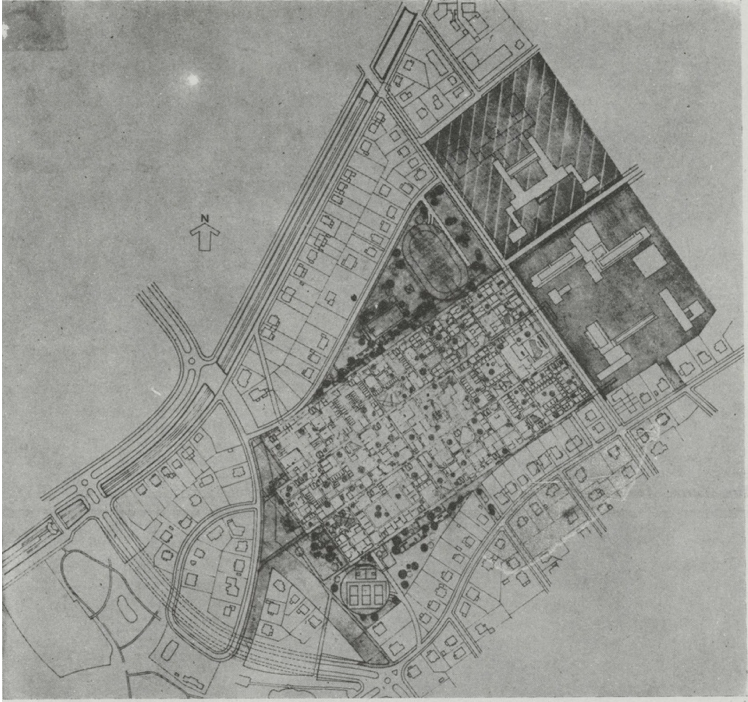
Figure 1: Candilis, Josic, Woods, and Schiedhelm, Masterplan for Berlin Free University, C. 1960, drawing.
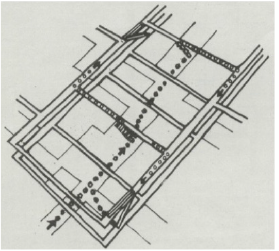
Figure 2: Unknown, Groundscaper typology creates meandering style of circulation, shown in dotted line, C. 1960, drawing.
Architecture has often been involved in aspirations for the creation of a utopia, prompting thought on whether form follows human patterns, or rather, directs them. The structuralist architecture of the 1960s reflects the strain of this dynamic, emphasising user participation in the configuration of structures that lie within an enforced and static urban framework. This is especially compelling in Candilis-Josic-Woods’ design for the Berlin Free University (BFU), which follows this model of a restrained flexibility, perhaps reflecting the precarious socio-political position Berlin was in, being divided into dual American and Soviet authority. The university is stuck in a sense between two versions of utopias, and their complementary dystopias. A mediation between binaries is similarly struck in Herman Hertzberger’s Centraal Beheer office complex, balancing a commercial client, with his underlying egalitarian philosophy. In both cases, the architects allow their designs to be two things at once by humanising them, conceiving of the perfect built form as one that facilitates the human condition in its current state, as opposed to a utopian ideal. Leaning on structuralism’s connection to linguistics and anthropology aids in this strategy, as human behavioural and communication patterns become a significant part of the architecture. Somewhat paradoxically, this becomes an attempt to immortalise their work from becoming obsolete with cultural evolution, as the structures evolve in tandem.
Candilis-Josic-Woods’ interest in a ‘total architecture’, that is, how the individual buildings come together to form the tissue of urbanity, is articulated in their stem and web theory, which goes on to manifest in their groundscaper typology at BFU. The concept plan is formulated from the overlay of two grids, the first being four parallel stems of circulation, connected by secondary paths that run perpendicularly. Figure 1 shows the ‘possibilities for growth’1 and integration these paths have into the surrounding site as the stems are equally spaced as those of the adjacent streets and the buildings are at a similar scale. Speaking to their belief that ‘it is useless to consider the house except as part of the community.’2 This can be inverted to come to mean that the community is a part of the house, and applying this to BFU, characterises universities as their own miniature cities.
The horizontal direction of this city’s densification challenges the American skyscraper, whose ‘planes of isolation’3 prioritised individual prosperity. BFU on the other hand spatialises equality in its low-rise design as all faculties are on an even footing (figure 2). The three levels are partitioned according to function – ground for storage, first for activities, third for classrooms and offices, and an unrealised fourth for apartments – as opposed to importance, and thus there is no hierarchical pattern, significant in encouraging interchange, especially amongst relationships – for instance, teacher and student – that do have an inherent imbalance. Candilis-Josic-Woods were critical of the car for stifling an awareness of other people that is forced by walking down a street4, and further that the inclusion of provisions for cars, turned a city into a suburb. This attitude, when looked at from the perspective of BFU’s exclusion of cars and elevators, draws a link between the two technologies, conceiving of density in a wholly different way to how it was being handled in the US. Therefore, the ‘Free’ in the universities name is not synonymous with American, forging an identity in-between the Eastern and Western utopian binaries.
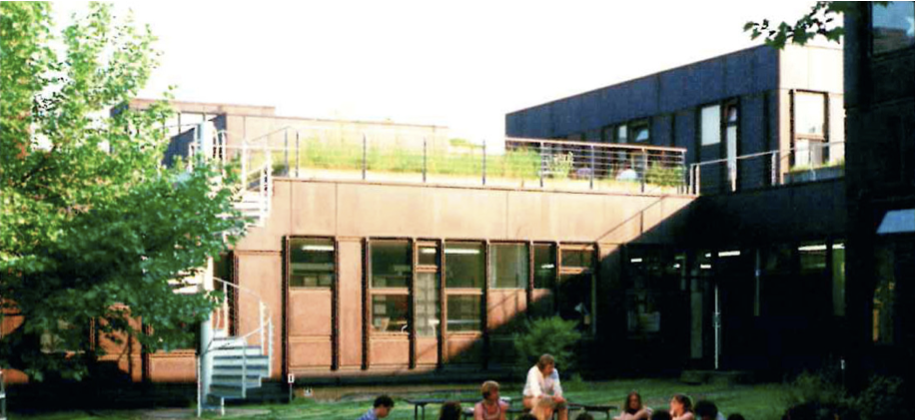
Figure 6: Manfred Schiedhelm, Roof gardens at Berlin Free University, C. 1965, photograph.
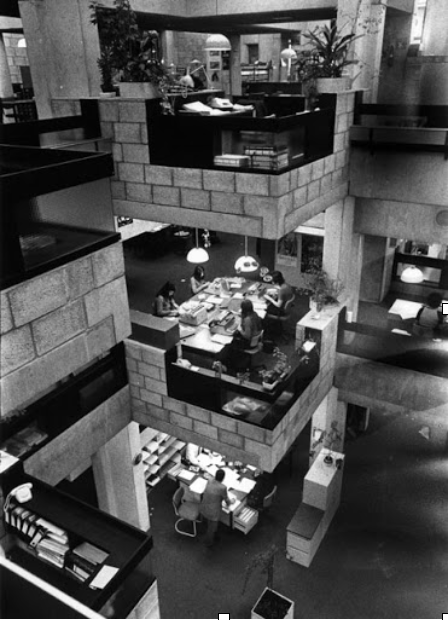
Figure 3: Johan van der Keuken, Office cubicles overhanging circulatory areas, 1972, photograph.
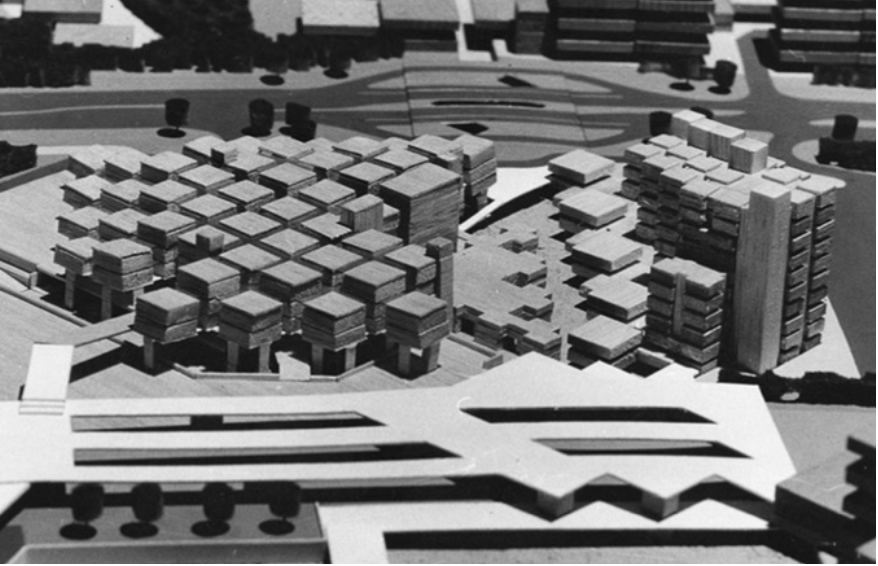
Figure 4: Herman Hertzberger, Aerial view of model of Centraal Beheer, C. 1960, photograph.
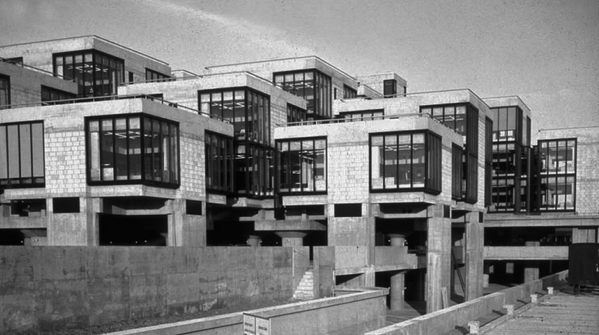
Figure 9: Unknown, Glass windows on Centraal Beheer facade, C. 1972, photograph.
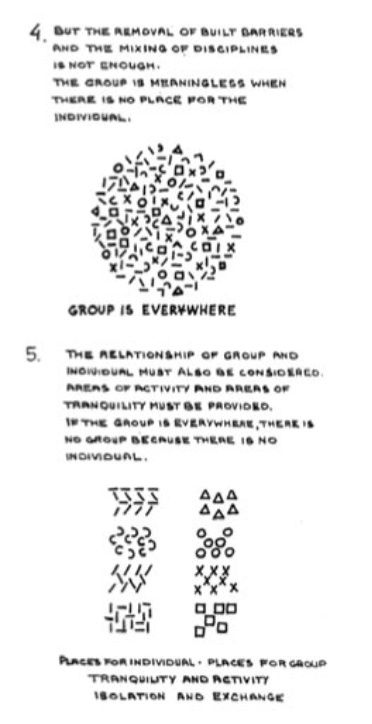
Figure 8: Unknown, Concept diagrams of individual and collective relationship at Berlin Free University, diagram.
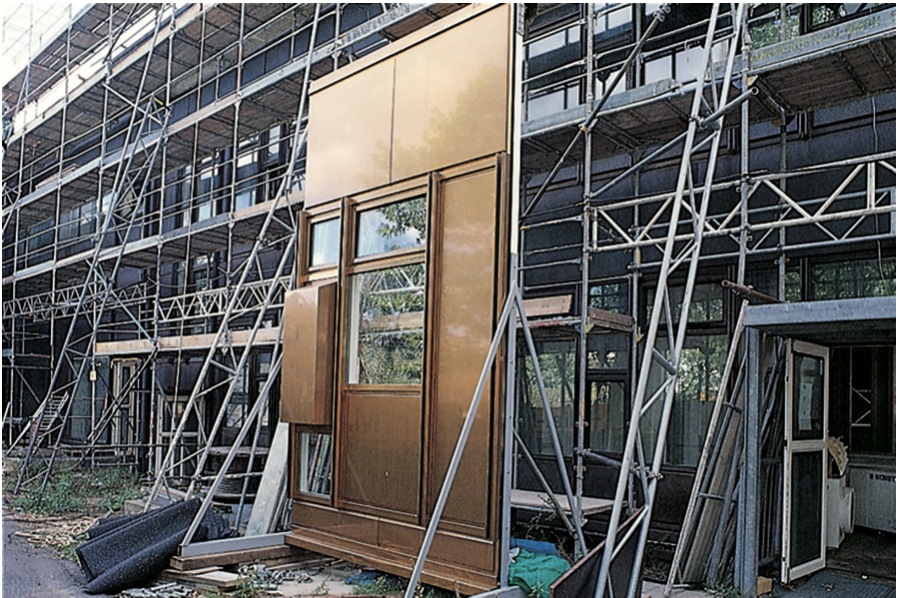
Figure 10: Unknown, Cor-Ten steel prefabricated modules in construction at Berlin Free University, photograph.
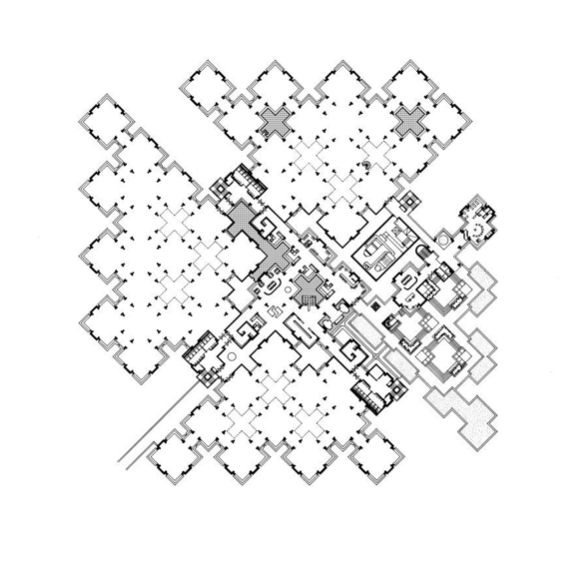
Figure 11: Herman Hertzberger, Plan of Centraal Beheer showing square office spaces with bridging void spaces, C. 1972, drawing.
We see a similar expansion of the notion of what it means to live in a place in Hertzberger’s almost residential approach to the design of the Centraal Beheer office building. Just as where we are taught is a micro-community, so becomes the place where that education leads us, where we work. The arrangement of four cubicles that overhang onto a crucifix shaped plaza to face each other as seen in figure 3, initiates a dialogue between the individual and their collective, that is reminiscent of historic European town squares bordered by apartment balconies (especially as there is greenery, which externalises the modules). We sense from this that there is a universal relationship between self and others that Hertzberger felt was important to transfer to the functions of modern architecture, whose ‘only possible future lies in the past.’5 The connection to European city planning is repeated from an aerial perspective, as in figure 4, the pattern of structures and spaces in between form the illusion of the ‘street pattern of a medieval town’6. Its elevation from ground level marks its modernity, layering it on the foundations of the past, an allusion to the structuralist paradox of reformation under invariant principles.
Hertzberger parallels his interest in the individual and collective with the relationship of nature to culture, animating the Centraal Beheer building with its capacity for change. The diagrams of figure 5 visualise Hertzberger’s polyvalency concept, as the form ‘without changing itself can be used for every purpose.’7 This also features in his design of De Drie Hoven, an aged care home that limits reallocation as needs change as the rooms go through the cycle of life with the user. Structuralism’s link to anthropology presents itself here, there is a universal human nature, represented by Hertzberger as the recurring module, that is expressed in different contextual ways, just as the programme within Hertzberger’s module shifts.
Candilis-Josic-Woods make ambiguous architecture’s cultural identity, by introducing the possibility of its natural one, as they subvert the customary progression from natural to built landscape. Corbusier’s influence can be detected in their roof gardens of figure 6, which invert the idea that architecture is built atop the natural world, and is therefore a separate entity from it. One accesses these gardens from external staircases, a transference of internal design to the outside, which is paralleled at Centraal Beheer. Again, Candilis-Josic-Woods are occupied with the idea of constructing a total landscape, one that embraces both the ‘space that is made, and space left over’8 as intentional parts of design. However, inherent in the phrase landscape design, is a level of moderation, evident in Woods attitude that ‘one must also be modest with green spaces in cities,’9 or taken another way, culture’s power to overtake nature. But again, this is not so straightforward, as nature is self enduring, whereas architecture is a product of the culture, and so relies on the impossibility of it staying the same. To what extent then, does urbanisation obscure the utopia that is pure natural form.
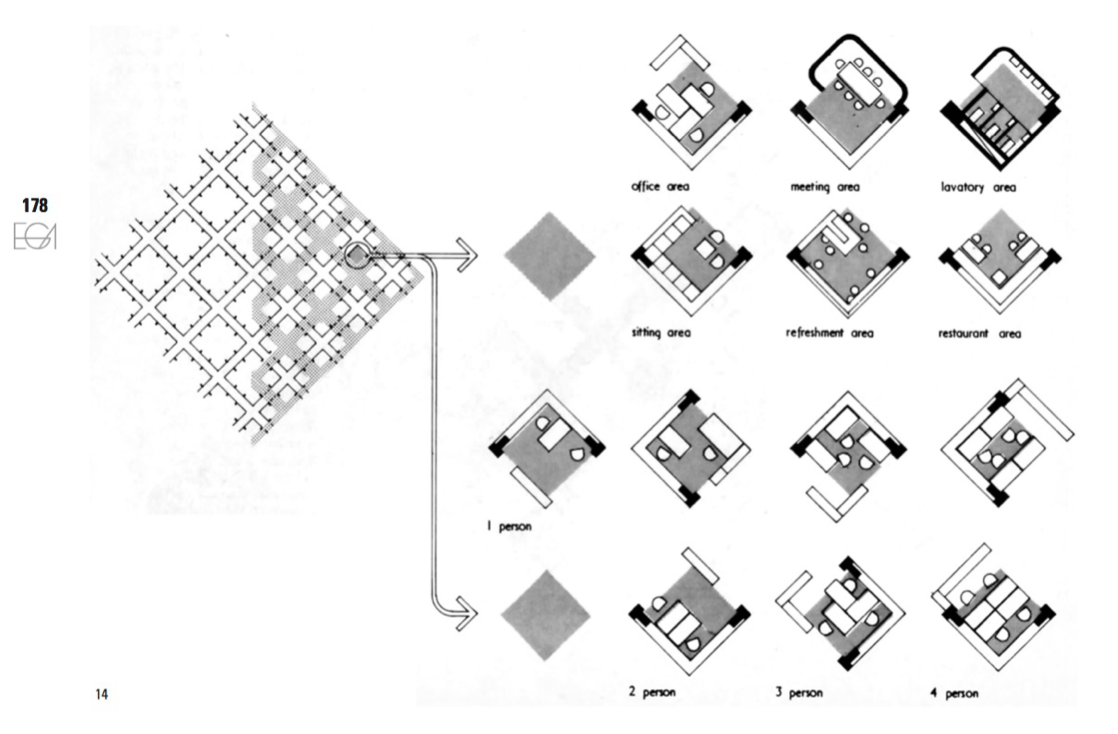
Figure 5: Herman Hertzberger, Diagrams of polyvalent functions of spaces, C. 1975, drawing.
The aesthetic character of BFU also becomes entangled in this idea as rooftop gardens make greenery almost ornamental. This is an interesting take on the issue of ornament, which had been denigrated as gaudy before the war, and became almost immoral in the post war climate. Modernism sought an honesty in expression of form, a shift that interestingly coincided with greater construction technologies that freed the façade from structural responsibilities. Central to the perceived problems of ornament, was its proneness to obsolescence, making its extravagance seen especially wasteful. Candilis-Josic-Woods were critical of the soullessness of the cities this approach created10, and contemporised ornament by making it human.
Just as Hertzberger leans on structuralism’s connection to anthropology, Candilis-Josic-Woods draw from its origins in linguistics to reintroduce language into architectural expression. Human interaction becomes communicative of the wider social atmosphere, in a way that ornament had formerly been, and is uniquely able to adapt to its changes. This concept is represented in the colour scheme of BFU (figure 7), wherein colours come to identify the different disciplines in their integrated groupings. Therefore, one of Candilis-Josic-Woods’ more explicit expressions of ornament, symbolises its more subtle one – human dialogue. It also becomes part of an organisational system, placing the individual amongst the collective (figure 8) in a sensitive way, so that the former is not lost. Their arrangement around a shared, wide corridor, from which they are accessed by (almost a plaza), creates opportunities for spontaneous exchanges and points to a belief that a successful architecture is one that is always in use. Structuralist architecture therefore has a somewhat anonymous aesthetic identity, instead being ‘about keeping people together’11 who then come to fill that aesthetic.
The loss of ornament in Hertzberger’s design, creates a visual fluency from inside to outside, inviting communication between the people occupying both spaces. The vertically stacked windows of figure 9, invite the outsider to observe the inside and vice versa, and therefore humans assume an ornamental position, as they fill the glass canvas. This canvas is illuminated by natural light that reaches into the building from ceiling windows, another invitation extended to the natural world. In doing this, Hertzberger associates his design with an idea of transparency, which bleeds into the issue of architecture’s engineering of society, and can be read as a rejection of that approach to design. This is significant within The Netherlands at the time, which naturally leant towards a socialist philosophy, but seeing its corruption in The Soviet Union, was politically aligned with the US. The glass windows of Centraal Beheer signify inclusivity in a way that those in American skyscrapers didn’t, being relatively low-rise, they are at a human scale, and thus there is a proximity created by the feasibility of access.
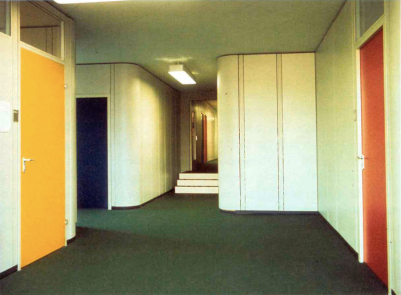
Figure 7: Unknown, Classrooms identified by colour coded system and face onto shared corridor, C. 1965, photograph.
Transparency is continued internally, and has the effect of removing a hierarchical order, which speaks to architecture’s ability to actively make an impression on culture. All cubicle spaces are open, visual and auditory contact therefore becomes public, setting a standard for modes of behaviour, and also encouraging greater productivity, as it is on display. The openness of the plan leads into Hertzberger’s interest in the placemaking of intermediary zones12, as articulation from one place to another is lessened. The notion of circulation becomes almost a double entendre, being both a literal means to a destination and also a meeting place, at which ideas circulate. If anything, it is the circulation that is given hierarchical precedence, as it is the only static element to the design.
Prefabrication imbued architectural forms the flexibility that Candilis-Josic-Woods’ were interested in for the longevity of their work. Engineer and architect, Jean Prouve’s involvement in the construction of BFU introduced a modular wall system, based on the dimensions of Corbusier’s Modulor. Again, this connects to anthropological structuralism, as it emphasises architecture’s primary objective as being to facilitate human activities. Therefore, the materiality becomes a unit, whose arrangement is subject to the changing expression of human nature. The use of Cor-Ten steel (figure 10), that will rust over time, and achieve a faded look, contrasts with its metamorphic abilities, pronouncing its age, which serves to simultaneously objectify and personify it, another allusion to the duality of opposites.
In his treatment of solid and void spaces, Hertzberger breaks up the intensity of activity, with tranquillity. The intersecting axial void spaces, impress a physical expansiveness in a highly dense environment, making it more liveable, and therefore working becomes a more positive experience. The void spaces also anticipate transformation of the active spaces, as there is room for reconfiguration. However, this is countered by the rigidity of the grid, which doesn’t allow for expressions of form outside the geometric square. Figure 11 gives a sense of how the voids mediate between the individual and the group, connecting the otherwise rather self-contained modules, almost like bridges spanning islands. BFU’s active spaces are similarly joined by the foil of tranquillity, in the form of external courtyards that are articulated by changes in roof height (figure 12). The void spaces at Centraal Beheer interestingly extend from the passages of circulation, by which Hertzberger is perhaps suggesting that progressiveness occurs as a reaction to an opposite.
Hertzberger and Candilis-Josic-Woods strove for the persevering relevance of their work, employing strategies of polyvalency and flexibility, respectively. And in doing so, carve out an intermediary zone for architecture, as both a product of the culture and actively affecting it. From this we perceive that the intentional planning of a utopia doesn’t align with its definition, as it can end up creating a culture, rather than facilitating the existing one. This is especially interesting when considered within the context of the cold war, wherein two binary cultures identified themselves as the ideal by articulating the ways in which the other was dystopian. Architecture is therefore capable of change, because it can be its instigator, however it is in constant dialogue with society, and therefore, in imbuing their structures with a humanness, both architects break down the distinction between culture, nature and structural form.

Figure 12: Herman Hertzberger, Section of Berlin Free University showing courtyards defined by roof height changes, C. 1972, drawing.
References
Avermaete, Tom. “’Comment Vivre Ensemble’: Imagining and Designing Community in the Work of Candilis-Josic-Woods.” Building Material, no. 16 (2007): 70-75. https://www.jstor.org/stable/29792315.
Candilis, Georges, Josic, Alexis and Woods, Shadrach. “Project For The Free University of Berlin.” Ekistics 18, no. 108 (1964): 369-372. https://www.jstor.org/stable/43616710.
Grijalba Bengoetxea, Alberto, Grijalba Bengoetxea, Julio and Merino del Río, Rebeca. “Representing Time: Spatial Polyvalency in Diagoon Housing and Centraal Beheer.” Architectural Graphic Expression Magazine 25, no. 38 (2019): 169–179. 10.4995/ega.2019.9571.
Han, Jiae & Lee, Sang-Hek. “Intermediate Design Strategy of Candilis-Josic-Woods’ Urban Complex.” Journal of Asian Architecture and Building Engineering 15, no. 1 (2016): 89-94. https://doi.org/10.3130/jaabe.15.89.
Hertzberger, Herman. “Flexibility and Polyvalency.” Ekistics 15, no. 89 (1963): 238-239. https://www.jstor.org/stable/43616104.
Hertzberger, Herman. “Social Space and Structuralism.” OASE, no. 90 (2013): 19-23. https://www.oasejournal.nl/en/Issues/90/SocialSpaceAndStructuralism.
Schoenbaum, David. “The Free University of Berlin, or, How Free Can a University Be?” American Association of University Professors 59, no. 1 (1973): 5-9. https://www.jstor.org/stable/40224664.
Smithson, Alison. “How To Recognise and Read Mat-Building: Mainstream Architecture As It Has Developed Towards The Mat-Building.” Architectural Design, September 1974.
Söderqvist, Lisbeth. “Structuralism in architecture: a definition.” Journal of Aesthetics & Culture 3 (2011): 1-5. http://dx.doi.org/10.3402/jac.v3i0.5414.
Team X. “Doorm Manifesto.” Team X Online, 1968. Accessed May 8, 2021. http://www.team10online.org/team10/text/doorn-manifesto.htm.
Tyrwhitt, Jaqueline & Woods, Shadrach. “From webs and stems to the continental city: Selections from People in the Street.” Ekistics 37, no. 223 (1974): 403-405. https://www.jstor.org/stable/43618321.
Vialland, Roger & Woods, Shadrach. “Conversation on Urbanism.” Perspecta 11 (1967): 56-57. https://www.jstor.org/stable/1566934.
Wensing, Thomas. “Herman Hertzberger Architecture and Structuralism – The Ordering of Space.” Blueprint, Jan/Feb 2016.