Teotihuacan & The Empire State Building:
A Discussion on Mesoamerican Influence on the Art Deco Skyscraper
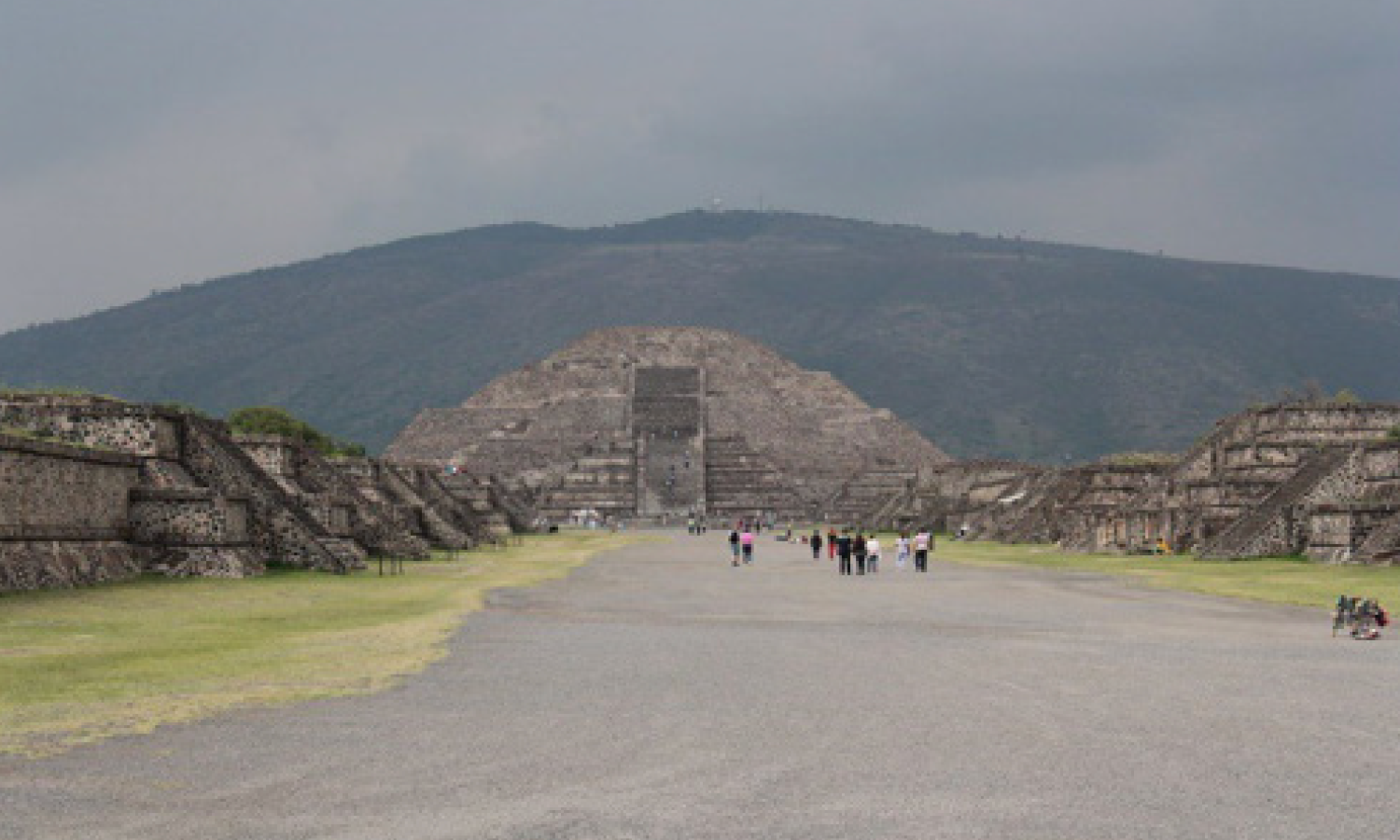
Figure 2: Arian Zwegers, Teotihuacan, Pyramid of the Moon, Cerro Gordo and Avenue of the Dead, 2015, photograph.
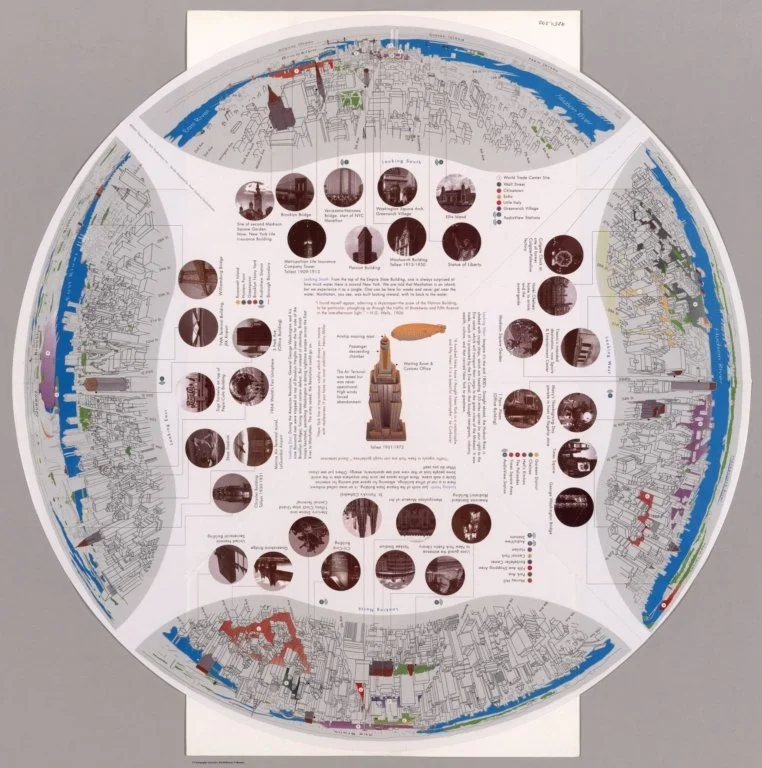
Figure 4: Keith Godard, Empire State Building, A Guide to the Views, 2007, 42 x 42cm, David Ramsey Historical Map Collection.
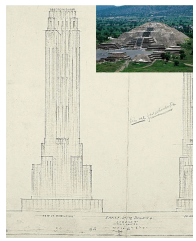
Figure 5: Shreve, Lamb and Harmon, East (5th Avenue) and North (34th Street) Elevation, 1930, pencil on tracing paper, 13 x 14”. With inset, Pyramid of the Sun.
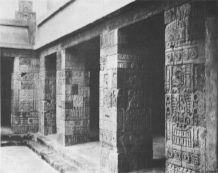
Figure 7: Unknown, Interior of the Temple of Quetzalpapalotl. Low relief carvings on the columns, 4th century, stone, Teotihuacan.
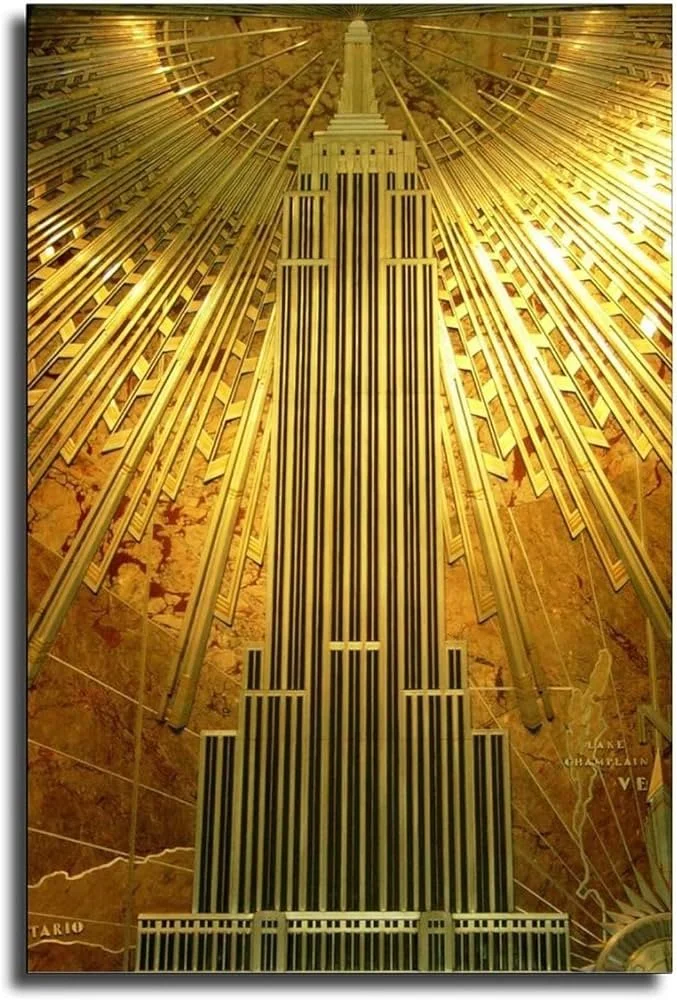
Figure 8: Leif Neandross, Empire State Mural, 1930, aluminium and gold leaf, Empire State Building lobby.
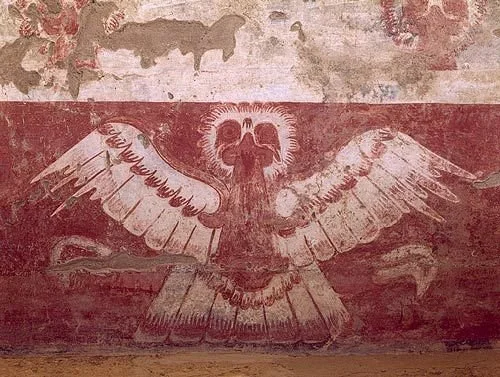
Figure 10: Unknown, Mural from Tetitla, Teotihuacan.
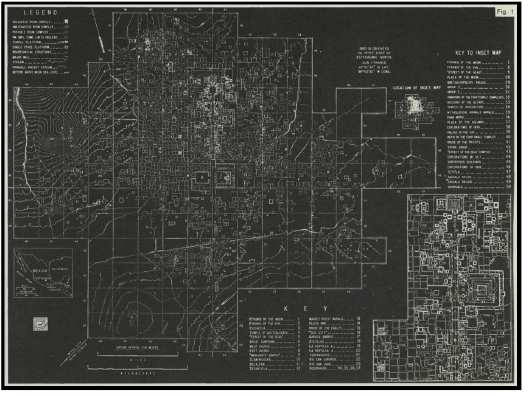
Figure 1: René Millon, The Teotihuacan Map, 1972, drawing.
Architecture erects the history and identity of a civilisation, in a sense forming the landscape of the human condition amidst the landscape of the natural one. The Empire State Building articulates the burgeoning identity of 20th century America, by reconnecting with the history of Mesoamerican architecture. And in doing so, forges a kind of architectural independence from Europe. Solidifying its strength by drawing on structural and ornamental designs evocative of the ancient Central Mexican city of Teotihuacan. The fact of their urban contexts premises the comparison, both as cultural and commercial capitals with diverse populations. In regarding the architecture of Teotihuacan – focusing on the three most significant pyramids of the city – there surfaces a similarity in form, obscured somewhat by the vast technological gap between them. In the resurgence of ornament characteristic of the Art Deco movement in architecture, motifs representative of the cosmological ideas of Teotihuacan are repurposed within the Empire State’s façade to express the power of America as its own state. With the appropriation of pre 8th century aesthetic characteristics into revolutionary 20th century architecture, arises a contentious consideration of the truth of representation, as the imagined form of an idea has the capacity to endure past an idea itself. This is perhaps especially compelling in the case of Teotihuacan, whose origins remain unknown, and thus whose forms of representation are impressionable to later worldviews.
Considering the context from which architecture is constructed, prompts reflection on its dual nature as both creating the context and being a piece within it. The densely built aspect of Teotihuacan emerges from a precise gridded ground plane, centralised along the five kilometer long Avenue of the Dead, which ‘articulates the most important public buildings’1 ; The Pyramid of the Sun, The Pyramid of the Moon and the Pyramid of the Feathered Serpent (figure 1). This serves as the hearth of the city, which at its peak in the mid fifth century had a conservative estimated population of 125,0002. The monuments appear to project the topography of the landscape in their form, suggestive of the intimacy between the human condition and the natural one. Reflecting this dynamic, The Pyramid of the Moon is defined by the Cerro Gordo mountain, which serves as a visual endpoint to the Street of the Dead and the foundation of the 15° 25’ orientation of the urban plan3 (figure 2). Similarly, the Pyramid of the Sun is composed in the space between two significant mountains, in the first instance being shadowed by the Cerro Patlachique mountain and in the second an imitation of the adjacent Cerro Malinalco. The mountain’s association with notions of territory and state autonomy essenced their significance, communities either ‘worshipped at hills or built their own emulating form.4’ Coupled with the manner in which the temples act as a passage between the underworld and the cosmological realm, as in the case of The Pyramid of the Sun, built upon the cave from which humans were believed to have emerged, in an east-west axial direction that traces that of the sun, they act as a symbolic reconstruction of the world. alluding to the animate quality of the architecture of the city5.
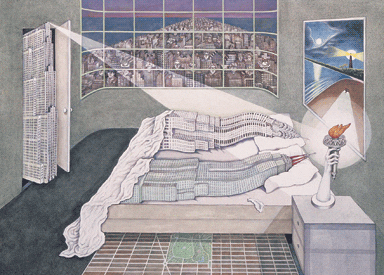
Figure 3: Madelon Vriesendorp, Flagrant délit, 1978, print.
The Empire State Building rises from a similar grid network, however its form is an interior reflection. Existing within the framework of the late 19th century philosophy that form follows function, the Empire State’s function is certainly inwardly focused. Large setbacks access greater light and air in the floor plan, so that the offices are experienced as expansive. While the pyramids at Teotihuacan also have setbacks, they are inextricably tied to the talud-tablero mode of construction – whereby a ‘steep sloping wall (talud) is surmounted by a table-like right angled panel with inset (tablero)’6 and are part of the external spatial impression of the site. The sparse reach of light to the interior of the pyramids casts an atmosphere of intimacy, indicative of their ritualistic functions, as places of sacrifice and burial. Similar to Teotihuacan, though, the Empire State seems to transcend the human condition. Personified in the cover to Rem Koolhaas’ manifesto ‘Delirious in New York,’ the skyscraper is put forth as the cause of the city’s culture of congestion - ‘Manhattanism7.’ The skyscraper beams light from its tip, implying an almost divine omniscience (figure 3). This argument prompts reflection on how the built form of a place orientates our conception of the natural one. The great height of the pyramids at Teotihuacan prompt one to look up, and thus to communicate with an influential but unknowable world above. The Empire State inhabits that world, however once amongst it, the intended view is one reflected downwards (figure 4). Thus, the object of height compels the culture in two conflicting ways, pronouncing the vulnerabilities of representation. However it also speaks to the ubiquity of architecture, designing the natural world through its placement of the built one.
The character of architecture is initially represented in its shape, the silhouette of the Empire State Building, articulated in the 34th street elevation, begins to grasp its connection to the pyramids of Teotihuacan in ‘the similarity of their massing8,’ (figure 5). This argument – of the infusion of pre-Columbian aesthetics into the form of the skyscraper – was first forwarded by Francisco Mujica a year before the Empire State was commissioned. Looking at the drawing with the image of the pyramids in mind, the skyscraper seems to take the shape of an elongated pyramid. One that has abstracted the unity of its vertical and horizontal proportions to magnify the perception of its own scale. This approaches the building’s principal intention – height. The architects focussed this in two ways, firstly, to be the actual tallest, measuring 381m, and then in decreasing some of its footprint, so that by the thirtieth storey it occupied ¼ of its site9. Creating the impression from the street of greater verticality, against the relatively condensed horizontal plane. In doing so, Shreve, Lamb and Harmon articulated the distinction of the experience of size from the reality of it. To reinforce this, the architects contrasted the soaring height of the upper floors with a five-storey base of human scale, grounding both the actual building and the experience of the building. A similar technique can be seen in the ceremonial pyramids at Teotihuacan, which are surrounded by four to five levelled miniatures of themselves. It is almost as though the smaller pyramids have been created in the image of the ones that symbolise their Gods, the amplified impression of physical height underscored by its religious significance. From this point, height functions to communicate the authority of a building in its setting, perhaps most compellingly due to the span of its visibility. Thus, the Empire State’s inflated verticality, rather than countering that of Teotihuacan’s, is perhaps a continuation on the same theme, mobilised by technological advancements.
These progressions signal the invention of the skyscraper, whose steel framework of vertical columns and horizontal beams interiorise form. The suspended curtain walls thus occupy an ambiguous identity, free from structural constraints10, to what extent do the choices concerning them become ornamental. The architects ran with this in full stride, fixing the site in the sky by building from the top down. The building’s revival of the archaism of ornament within the landscape of functional modernism, forges an Art Deco-ism unique to America. In this spirit, features formerly limited by construction technologies, could traverse functionality and ornamentality. Striking this dualism are the windows of the Empire State, which together with the intersecting aluminium spandrels, appear to lie on the vertical plane, and so become part of its upwards directional line. Indiana limestone clarifies these lines with its own strokes, whose soft colour contrast with the metallics of the window framing. The effect is almost of conveying the structural reinforcements ornamentally. Assuring the belief ‘that the thickness of a wall conveyed strength of the structure11,’ and preserving the perceptual association of wall materiality and stability.
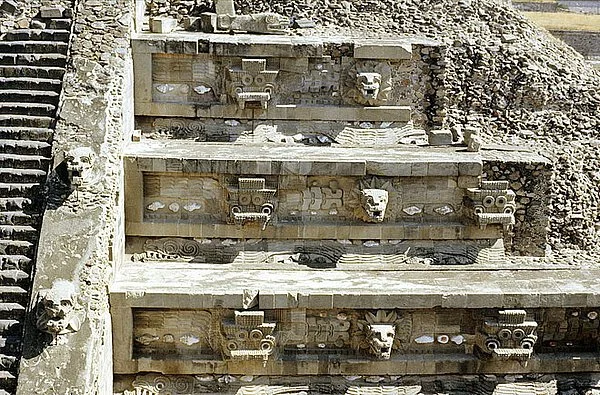
Figure 6: Unknown, The Temple of Quetzalcoatl. Detail face showing the arrangement of the decorative design of the panels, 4th century, stone, Teotihuacan.
Ornament and structure coincide in a more involved manner in the temples of Teotihuacan, as ‘the architecture is made to display the murals, and the murals give meaning to the architecture12.’ The Pyramid of the Feathered Serpent demonstrates this interwovenness in its ‘geometric style formed by stepped back superimposed stages, each with its own cornice13.’ From which feathered serpent heads are rhythmically alternated with the sculptural heads of a snake. This rhythmic alternation directs strong vertical lines to the top point of the pyramid (figure 6). The stone sculptures were originally painted in simple primary colours: red for the serpent’s body, yellow for the shells, blue for water, the exception being green for the feathers. Their ‘tendency toward a restrained simplicity14’ parallels the controlled use of ornament in Art Deco design. In a sense the figures are symbolic of windows, communicating the interior experience outwardly. Conversely, the sculptural element of the pillars that enclose a courtyard at the centre of the pyramid ‘embrace an intimate space,’ (figure 7). The avian figures that adorn them are a means of framing the area, ‘occupying structure rather than projecting from it15.’ These artistic components conspire to direct the experience of the space, the sculptures attracting one to the site, and the inscribed columns sealing one within it. An inversion of the spatial qualities when passing from exterior to interior at the Empire State, which instead dilates into open plan. Moreover, once within the corridors of the pyramids the paintings perhaps function to prescribe and describe human behaviour in the space16. Architecture, art and culture do not distinguish themselves at Teotihuacan, the art is the architecture, which in turn is the culture, and vice versa.
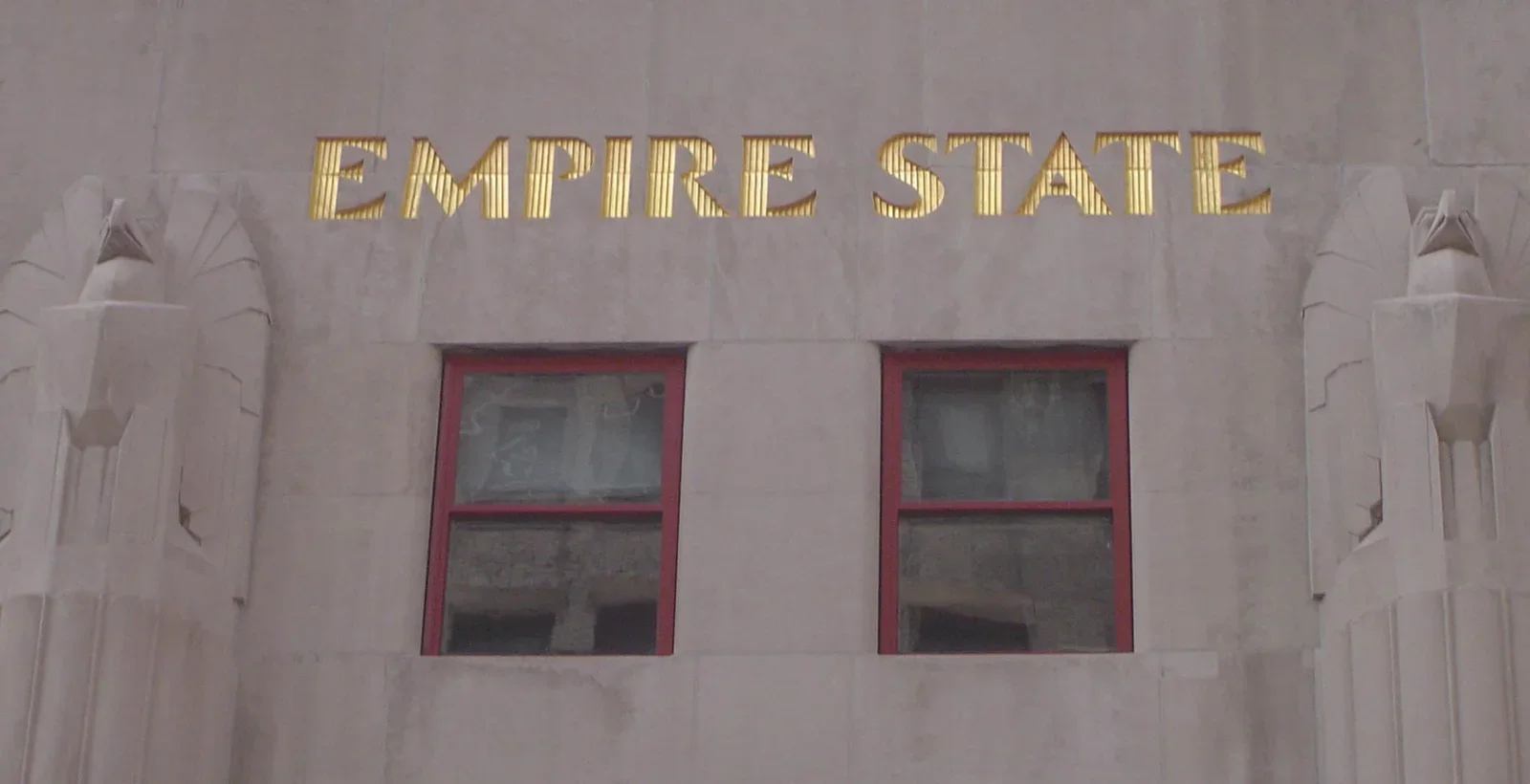
Figure 9: Shreve, Lamb and Harmon, Eagle sculptures, 1930, Indiana limestone, Empire State Building.
The Empire State Building appears to mythologise its architectural design in the art applied to it. The ground floor mural depicts beams of light emanating from the building’s tip, suggestive almost of a technological enlightenment (figure 8). In a somewhat meta manner, the medium of the mural seems to recognise a significant architectural shift, one argued by Raymond Hood, that the primary collaboration is no longer that of the ‘architect, painter and sculptor,’ but rather ‘the architect, plumber and engineer.’ And yet, the Empire State’s sculptural aspect adopts the iconographic representations of Mesoamerican culture, outlining the 350 Fifth entrance are two perched eagles (figure 9). The eagles signify the militaristic strength of America, an impression given more depth when viewed alongside the eagle mural at Teotihuacan, a city with its own militaristic formidability (figure 10). The birds are dually angled towards the past and the present, on the one hand possessing a tomb-like quality that roots them to pre-Columbian conceptions of the world’s origins – eagles were thought of as avatars of the sun by pre-Columbian cultures - and on the other hinting at the age of flight17. Interestingly, the Empire State expresses its modernistic culture with traditional art, layering the meaning of its representation.
The Empire State’s relationship to the city of Teotihuacan considers the movement of design ideals and representations through time, proving the influence of the past on the present to be less linear. Especially as the conception of the past is partial to the present. The Empire State embraces the spatial qualities of Teotihuacan in a somewhat inverted sense, perceiving a cultural shift in what the function of architecture is now – an expression of its interior life. Layering the skyscraper with imagery that root it to the stature of its past, pioneers a new meaning to that representation, one of America’s powerful individual identity.
References
Christianson, Scott. “When the Empire State Building Was Just an Architect’s Sketch.” Smithsonian Magazine, Nov 10, 2015. https://www.smithsonianmag.com/us- history/empire-state-building-1929-31- 180957195/.
Corbusier, Le. “Five Points of Architecture.” In Towards a New Architecture. Translated and edited by John Goodman. London: Frances Lincoln Publishers Ltd, 2008.
Fash, William L., and Leonardo López. The Art of Urbanism: How Mesoamerican Kingdoms Represented Themselves in Architecture and Imagery. Washington D.C: Dumbarton Oaks Research Library and Collection, 2009.
Hearn, Kelly. “Who Built the Great City of Teotihuacan?” National Geographic, January 1, 2017. Accessed April 5, 2020. https://www.nationalgeographic.com/subs cribe/magazines/?key=MAGSMULTIM.
Koolhaas, Rem. Delirious in New York: A Retroactive Manifesto for Manhattan. New York: Oxford University Press, 1978.
Lucero, Lisa. “Classic Maya Temples, Politics and the Voice of the People.” Latin American Antiquity 18, no. 4 (2007):
407-427. https://www.jstor.org/stable/25478195.
Marquina, Ignacio. “The Architecture of Teotihuacan Art in Mexico.” Teotihuacan: Place of Gods, no. 134 (1970): 27-48. https://www.jstor.org/stable/24316100.
Miller, Arthur. The Mural Painting of Teotihuacan. Washington D.C: Dumbarton Oaks Research Library and Collection, 1973.
Millon, René. “Teotihuacán, completion of map of giant ancient city.” Cities of the Past: Origins of Urban Settlements in Different Cultures 33, no. 195 (1972): 137-141. https://www.jstor.org/stable/43617993.
Mujica, Francisco. The History of the Skyscraper. New York: Archaeology & Architecture Press, 1929.
Robb, Matthew, and Patricia Sarro. “Passing through the Center: The Architectural and Social Contexts of Teotihuacan Painting.” In Memory Traces: Analysing Sacred Space at Five Mesoamerican Sites, 21-44. Colorado: University Press of Colorado, 2015.
Sacks, R., and R. Partouche. “Empire State Building Project: Archetype of ‘Mass Construction.” Journal of Construction Engineering and Management 136, no. 6 (2010). https://doi.org/10.1061/(ASCE)CO.1943- 7862.0000162.
Smith, Michael E. “The Teotihuacan Anomaly: The Historical Trajectory of Urban Design in Central Mexico.” Open Archaeology 3, no. 1 (2017): 175-191. https://doi.org/10.1515/opar-2017-0010.
Tauranac, John. “The Design.” In The Empire State Building: The Making of a Landmark, 153-170. United States: Cornell University Press, 2014.
Terry, James. “Talud-Tablero.” Art History Glossary (blog). September 4, 2011. http://blog.stephens.edu/arh101glossary/?s=talud-tablero.
Vit-Suzan, Ilan. “Sun Pyramid: Inventory of Denotation.” In Architectural Heritage Revised: A Holistic Engagement of its Tangible and Intangible Constituents, 75-104. New York: Farnham: Routledge Ltd, 2014.